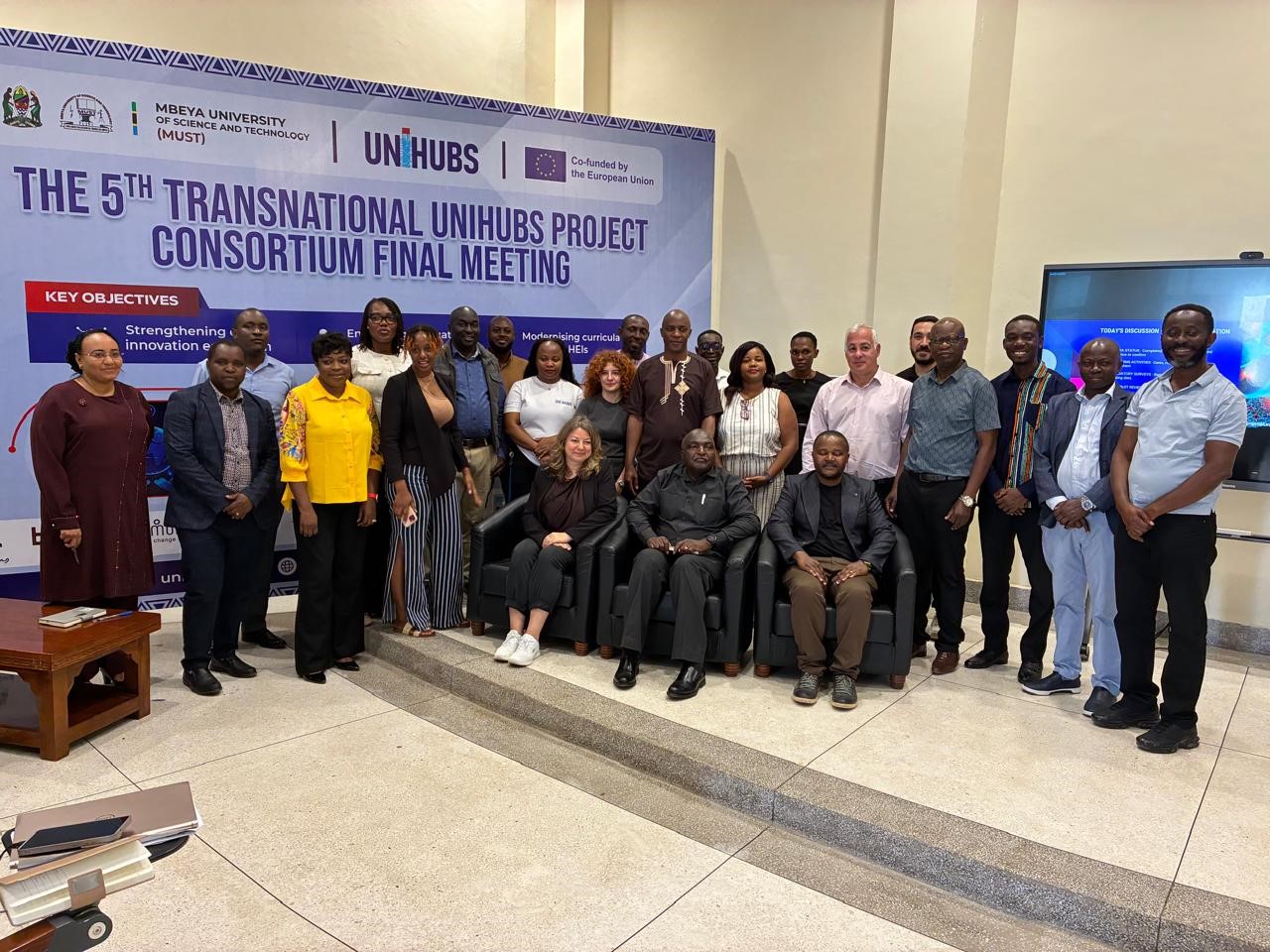
Kibabii University has joined partnership with higher education institutions and innovation ecosystems from across Africa and Europe for the fifth and final in-person project meeting of the UNIHUBS consortium. The meeting was hosted at Mbeya University of Science and Technology (MUST) in Tanzania on 18 and 19 November 2026. Representing Kibabii University at the two-day summit were the KIBU UNIHUBS Principal Investigator, Professor Paul Obino, alongside project team member Mr. Stephen Ogallo.
Bringing together seven African universities and partner innovation hubs from Kenya, Ghana, Tanzania, and Europe, the UNIHUBS initiative was conceived to help higher education institutions respond to a rapidly evolving labor market shaped by digitalization, entrepreneurship, technological disruption, and emerging forms of work. Across the continent, a persistent disconnect often separates theoretical university curricula from the practical realities of digital innovation ecosystems. Consequently, while graduates frequently enter the workforce with strong disciplinary grounding, they often lack structured opportunities to apply digital tools, exercise entrepreneurial judgment, collaborate in multidisciplinary teams, communicate effectively, solve complex problems, transfer technology, and engage directly with employers and innovation hubs.
To bridge this gap, UNIHUBS has worked to forge structured, enduring partnerships between universities and digital innovation ecosystems across participating countries. Over its implementation cycle, the project has pursued a comprehensive mandate centered on assessing institutional capacity needs, modernizing academic curricula, and strengthening international networks. Through this collaborative framework, the consortium has co-created a future-oriented educational package, delivered hands-on learning opportunities, and generated empirical insights designed to inform national higher education strategies.
Methodologically, the consortium integrated quantitative and qualitative research with capacity-building training workshops, collaborative co-creation of educational materials, and experiential learning. These initiatives were further reinforced through the rollout of an international online course, pilot implementations across partner institutions, rigorous evaluation, and broad knowledge dissemination.